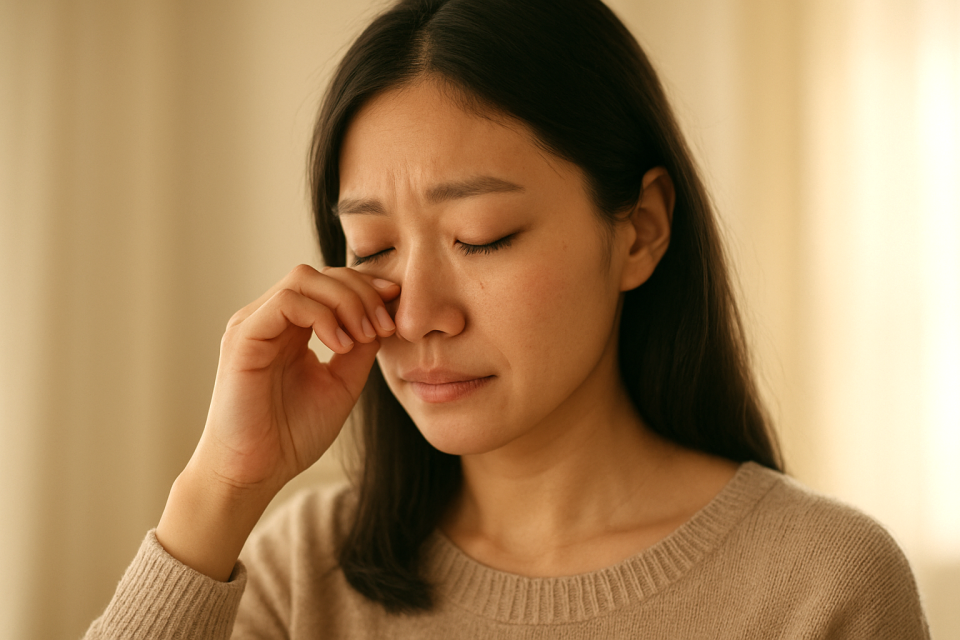
Have a seat, breathe, and let yourself be held in this little pocket of calm before the world calls you back. I want to talk to you about something tender, something most women feel but rarely say out loud. It’s the moment you look in the mirror after an emotional release, maybe after a hard cry, and you notice your face looks different. Softer. More open. More honest. Almost like the woman staring back at you is the truest version of yourself, stripped of expectation, stripped of performance, stripped of everything except what’s real.
People are quick to hide their tears, but I see beauty in them. Not the red eyes or the puffiness, those are just part of being human, but the openness that follows. There is a calm, almost sacred softness that settles into the face after you let emotion move through you instead of trapping it behind your ribs. Crying is not weakness. Crying is processing. Crying is the body’s way of saying, “I have held this long enough; let me release it now.” And because your skin is connected to your nervous system, your heart, your breath, your hormones, your tears are not merely emotional, they are physiological, cleansing in more ways than one.
So many women apologize for crying in my presence. They’ll wipe their cheeks and say, “I’m sorry, I don’t know what’s wrong with me,” and I always take their hands gently and say, “Nothing is wrong with you, your body is speaking.” Tears don’t come from weakness; they come from buildup. From holding too much. From trying to be too strong for too long without a place to set the burden down. And when you finally allow yourself that moment of release, the face responds almost instantly. It softens. It breathes. It stops bracing.
You may not realize how many expressions on your face are actually habits formed around holding things in. The tight mouth. The pinched brows. The flatness around the eyes. Crying loosens these patterns, if only for a moment, and reveals the real you underneath, the woman who feels deeply, who hopes deeply, who loves deeply, who tries deeply. And it’s beautiful. Not because of the tears themselves, but because of the truth that rises when they fall.
When women ask me what happens to their face after crying, I explain gently that tears do more than release emotion; they shift the nervous system, like an emotional detox. Crying pulls the body out of its tense, protective posture and into a state of surrender. And surrender changes the face. Before I tell you the signs, let me ease into this softly, because these changes aren’t cosmetic, they’re sacred:
After an emotional release, you may notice…
- your eyes look clearer, as if a fog has lifted
- your face feels warmer, more alive
- your breath deepens, and your chest feels less tight
- your jaw loosens without effort
- your skin glows subtly, the way it does after prayer or meditation
- the heaviness behind your eyes lessens
- your expression becomes more open and unguarded
- you look more like yourself, your true, unmasked self
These are not just physical shifts; these are emotional calibrations showing up where they’re easiest to see. Your tears don’t make you less beautiful; they reveal the beauty that stress temporarily hid.
And here’s something else I want you to hear: your face doesn’t change because of the tears alone; it changes because of what the tears communicate. Crying tells your nervous system, “We’re safe enough now to feel.” It’s an exit from survival mode. It’s a doorway into softness. It’s the moment your body stops running and starts returning. Crying is not the breaking point; it is the turning point.
You might feel vulnerable afterward, and that’s normal. Vulnerability is simply openness without pretense. It’s you without the armor. And in that softness, your face becomes more expressive, more radiant, more alive. Not because of cosmetics, not because of technique, but because honesty is beautiful. It always has been.
So the next time you cry, my friend, don’t rush to hide your face. Don’t apologize. Don’t assume something is wrong with you. Sit with yourself. Look gently in the mirror and say, “I see you. I’m proud of you for feeling.” Let the softness linger. Let the openness stay long enough to remind your nervous system that you are safe, held, and allowed to feel everything that lives inside you.
And if you ever need a space where you can soften without judgment, where you can release what you’ve been holding, where your tears are welcomed as a form of healing, I will be here, ready to offer warmth, gentleness, and support.
Let your body feel. Let your face soften. Let your heart speak.
There is beauty in every part of it.
With compassion that meets you where you are,
~ Eydie Claassen